Great leadership isn’t about having all the answers. It’s about asking the right questions. One of the most effective shifts a leader can make is moving from problem-solver to performance coach. Coaching conversations – when done well – create space for growth, ownership and improved outcomes across your team. They elevate everyday dialogue from transactional to transformational.
But many leaders hesitate.
What should I ask? How do I start? Will it feel forced?
You don’t need to be a certified coach to integrate coaching into your leadership practice. What you do need is curiosity, intention, and a few powerful questions in your toolkit.

7 Coaching Questions Every Leader Should Use to Improve Team Performance
Here are seven coaching questions I teach leaders to use regularly to improve team performance – questions that not only improve individual performance but strengthen capability, clarity and culture over time.
1. What’s working well for you right now?
Start with strengths. This question helps people reflect on their wins, however small. It reinforces what’s going right and builds confidence – a critical foundation for any coaching conversation.
Positive framing is also neurologically powerful. Research from Barbara Fredrickson’s broaden-and-build theory shows that positive emotions expand our thinking, increase creativity, and improve problem-solving (Fredrickson, 2001). Starting with what’s working primes the brain for higher performance.
2. Where are you feeling stuck?
This is where the real coaching begins. It opens the door for challenges, uncertainty or hesitation to be discussed safely – without the fear of judgement. It also signals to your team that you’re not just there to evaluate, but to support.
The key is to listen actively. Resist the urge to jump in with solutions. As the NeuroLeadership Institute highlights, insight often comes when people verbalise their own thinking (Rock, 2006). Your job is to hold the space.
3. What have you already tried?
Too often, people come to their leader expecting direction. By asking what they’ve already done or considered, you encourage ownership, initiative, and problem-solving.
It also prevents learned helplessness – the phenomenon where people stop trying to solve problems because they expect someone else to step in. Over time, this single question helps rewire a team’s default setting from “ask” to “act”.
4. What does success look like to you in this situation?
This question does two important things. First, it uncovers assumptions – theirs and yours. Second, it provides a chance to align expectations and definitions of quality.
Many performance issues stem not from a lack of effort, but from a lack of shared clarity. A recent Gartner study found that only 44% of employees believe their manager helps clarify performance expectations (Gartner, 2023). Clarifying success together builds mutual understanding and accelerates alignment.
5. What support do you need from me?
Simple. Powerful. Often forgotten.
This question positions you as a partner, not a micromanager. It also helps you understand the support gaps that might be blocking progress – whether it’s resources, clarity, feedback or time.
A meta-analysis by Gallup shows that employees who feel supported by their manager are significantly more likely to be engaged, resilient and high performing (Gallup, 2020). Support isn’t just about being available. It’s about being intentional.
6. What would you do differently next time?
This is your reflective lever. It turns mistakes into learning and feedback into growth. The tone here matters – it must be curious, not critical.
Encouraging this kind of self-assessment builds accountability without blame. It helps people develop their own playbook for continuous improvement and supports a growth mindset, as described by Dr Carol Dweck. When people believe they can improve through effort and learning, they become more resilient and motivated (Dweck, 2006).
7. What’s one thing you’ll commit to before our next check-in?
Every coaching conversation needs a close. Not just a summary, but a next step.
This question reinforces ownership and creates accountability. And when you revisit this in your next 1:1, you show that you’re paying attention – which builds trust.
Too many development conversations lose impact because they end without commitment or follow-up. According to McKinsey, regular check-ins are one of the key differentiators of high-performing managers (McKinsey & Company, 2023). Make them count.

When Should Leaders Use Coaching Conversations?
Coaching questions aren’t only for performance reviews or formal development chats. In fact, their impact is often greatest in everyday interactions — the quick 1:1, the team debrief, the “corridor conversation” after a project meeting.
Here are some of the best moments to apply coaching-style questions:
- During 1:1s: Move beyond task updates by exploring mindset, blockers, and growth opportunities.
- After a mistake: Use reflective coaching questions to drive learning instead of defaulting to correction.
- Before a project begins: Clarify expectations, build ownership, and encourage strategic thinking.
- At the end of a quarter: Explore progress and help shape future priorities and development goals.
- In succession or talent planning: Understand aspirations and readiness by inviting your team into the process.
By building these conversations into your leadership rhythm, coaching becomes a habit not a heroic intervention.
Coaching Conversation Toolkit
You don’t need to remember all seven questions word-for-word. You just need to remember the purpose they serve.
| Purpose | Try Asking |
| Start positive | What’s working well for you right now? |
| Uncover blockers | Where are you feeling stuck? |
| Encourage ownership | What have you already tried? |
| Align expectations | What does success look like to you? |
| Offer support | What support do you need from me? |
| Reflect and learn | What would you do differently next time? |
| Build accountability | What’s one thing you’ll commit to before our next check-in? |
Start with One Question
Start Small, Stay Consistent
If coaching feels unfamiliar or unnatural, start with one question. Pick a moment this week and shift your instinct from telling to asking.
For example:
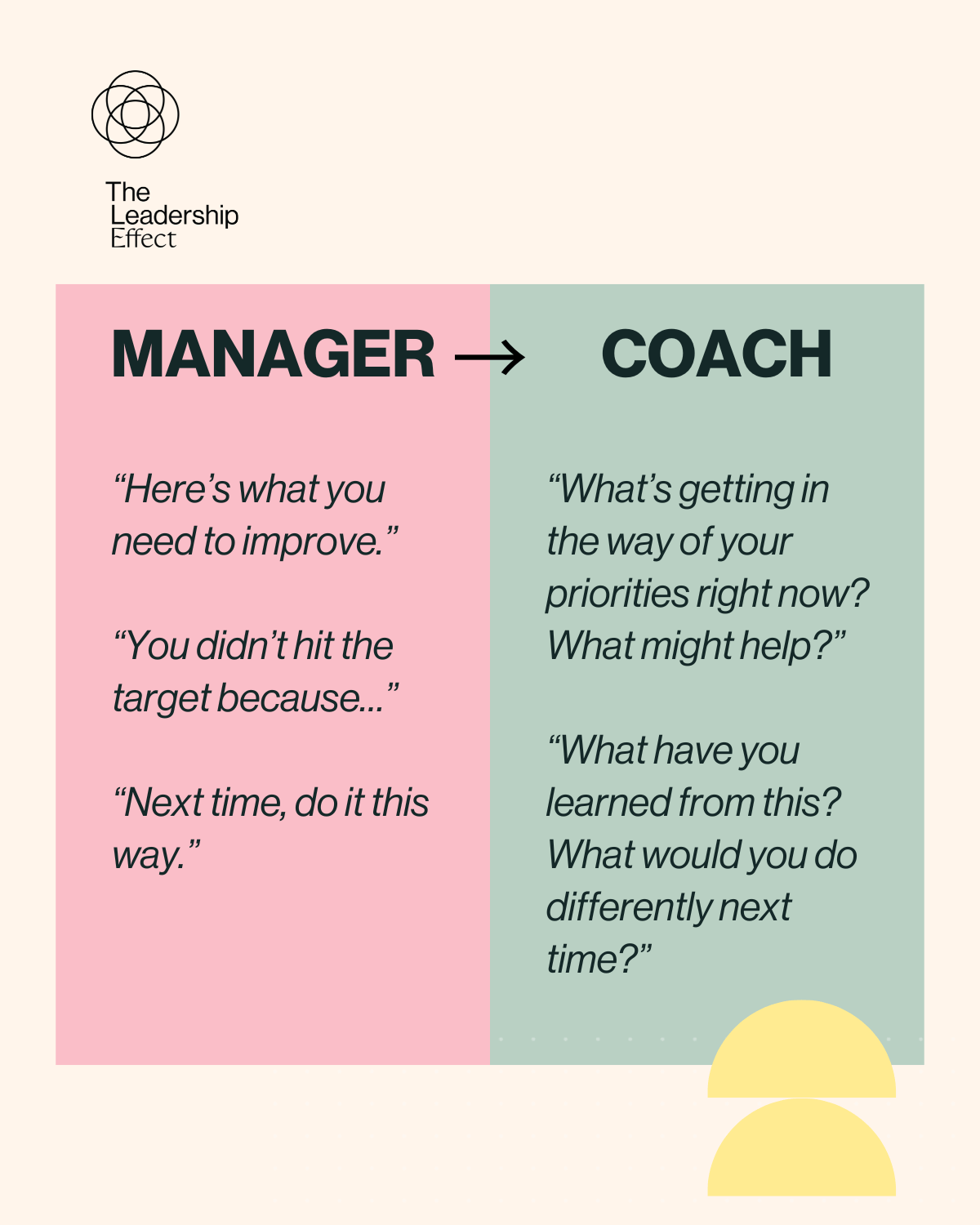
Instead of saying “You need to prioritise better,”
Ask “What’s getting in the way of your priorities right now?”
Over time, these questions shape not just individual performance but the entire team culture. They build trust, reduce reliance, and strengthen the team’s ability to think critically and act independently.
Great teams don’t wait for the formal performance cycle to learn and grow. And great leaders don’t wait for the perfect moment to coach.
They just start. One question at a time.
Coaching is a Leadership Skill, Not a Nice-to-Have
The seven coaching conversation questions in this article aren’t a script. They’re prompts to help you lead with more intention, empathy and clarity. Used regularly, they shift your leadership conversations from directive to developmental. That’s where performance grows.
If you’re constantly solving problems for your team, answering the same questions, or feeling like progress depends on your input… it might be time to shift how you lead conversations.
Because the strongest teams aren’t built through command.
They’re built through clarity, coaching, and curiosity.
Hosting effective coaching conversations is one of the most practical capabilities I help leaders develop through tailored workshops and 1:1 coaching. Let’s have a conversation to bring this skillset to yourself or your management team.
References:
- Fredrickson, B. (2001). The role of positive emotions in positive psychology. American Psychologist.
- Rock, D. (2006). Quiet Leadership: Six Steps to Transforming Performance at Work. HarperBusiness.
- Gartner (2023). Employee Performance Management Survey.
- Gallup (2020). State of the American Manager Report.
- Dweck, C. (2006). Mindset: The New Psychology of Success. Random House.
- McKinsey & Company (2023). The Manager of the Future: Leading in a Hybrid World.