Most leadership conversations revolve around finding the “right” way to lead. But the reality? There isn’t one.
Great leaders aren’t defined by sticking rigidly to a single style — they’re defined by their ability to read the room, understand the context, and adapt.
This is where leadership models come in.
They’re frameworks, not formulas.
They help you understand different approaches so you can flex between them depending on your team’s needs and organisational priorities.
Why Context Matters More Than Leadership Style
A leadership style that drives results in one situation can be a disaster in another:
- A crisis calls for clarity and quick decisions.
- A growth phase needs vision and coaching to build capability.
- A transformation requires inspiration, trust, and resilience.
The most effective leaders develop a toolkit of multiple styles they can draw on, rather than a single “default mode.”
5 Leadership Models and When To Use Them

1. Situational Leadership Model (Hersey & Blanchard)
Core idea: Adjust leadership style based on team members’ competence and commitment.
- Best for: Leading teams with mixed experience levels, onboarding new hires, or supporting skill development.
- How it works: Four styles — directing, coaching, supporting, delegating — matched to team readiness.
- Why it matters: Prevents under- or over-managing; builds capability and autonomy over time.

2. Transformational Leadership Model
Core idea: Inspire and motivate through vision, values, and personal example.
- Best for: Times of major change, growth, or cultural transformation.
- How it works: Focuses on big-picture purpose, innovation, and challenging the status quo.
- Why it matters: Builds high engagement and loyalty, but must be grounded in realistic support to avoid burnout.

3. Transactional Leadership Model
Core idea: Leadership based on structured rewards, consequences, and clear expectations.
- Best for: Performance-driven environments, compliance-heavy industries, or short-term goal execution.
- How it works: Uses systems, KPIs, and incentives to drive behaviour.
- Why it matters: Creates clarity and consistency but can feel uninspiring if overused.
4. Servant Leadership Model
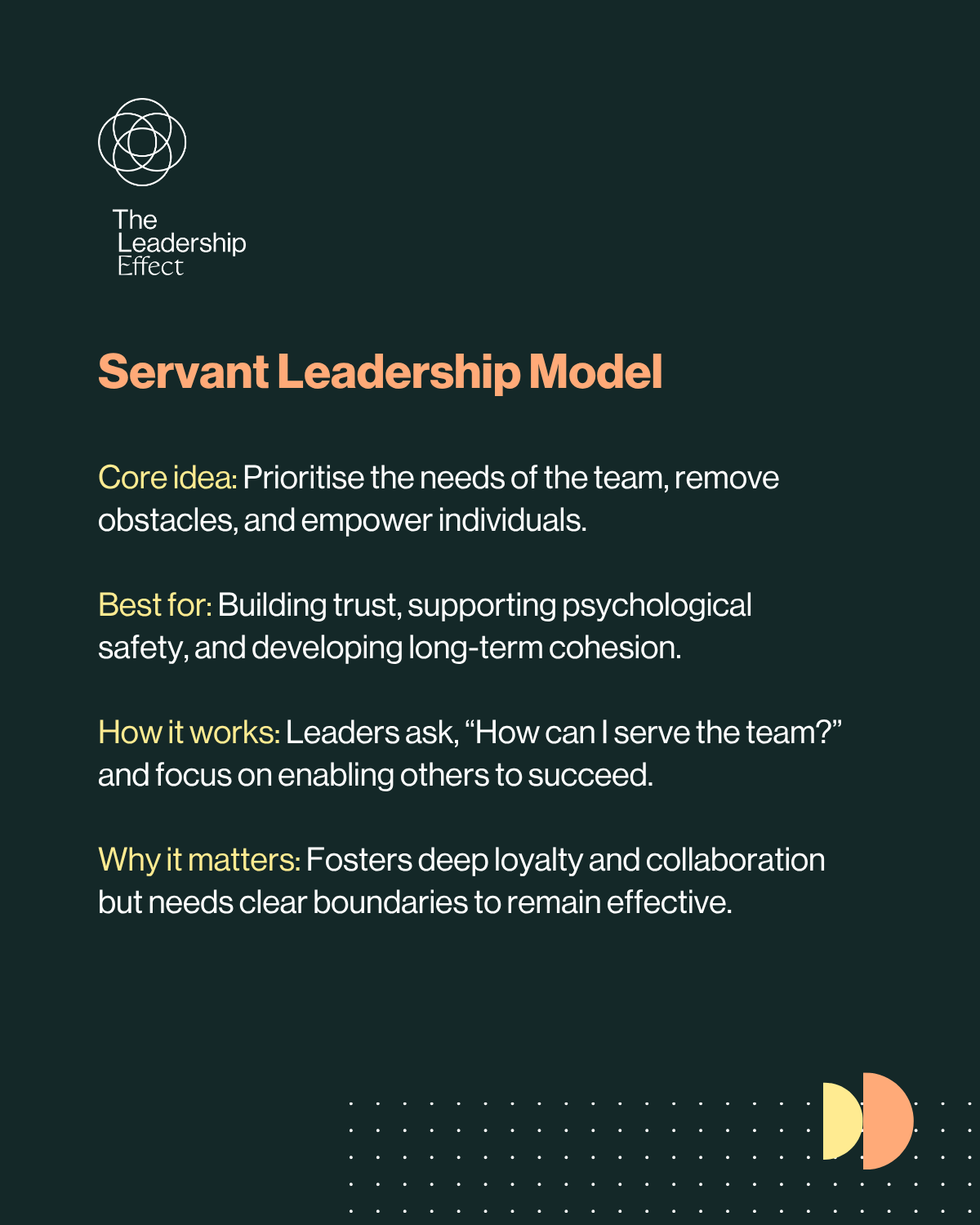
Core idea: Prioritise the needs of the team, remove obstacles, and empower individuals.
- Best for: Building trust, supporting psychological safety, and developing long-term cohesion.
- How it works: Leaders ask, “How can I serve the team?” and focus on enabling others to succeed.
- Why it matters: Fosters deep loyalty and collaboration but needs clear boundaries to remain effective.

5. Adaptive Leadership Model (Heifetz & Linsky)
Core idea: Help organisations navigate complex change by mobilising people to tackle tough challenges.
- Best for: Uncertain, rapidly changing environments (e.g., post-merger, industry disruption, AI integration).
- How it works: Distinguishes between technical problems (clear solutions) and adaptive challenges (complex, require learning).
- Why it matters: Builds resilience and equips teams to thrive amid ambiguity.
How To Know Which Model To Use When
Ask yourself:
- What’s the current state of the team? New, experienced, burned out, thriving?
- What’s the environment? Stable, growing, in crisis, transforming?
- What outcome is most important right now? Stability, innovation, speed, engagement?
Most leaders naturally favour one or two models, but real impact comes from flexing between them.
Practical Example: Switching Styles in Action
Leadership isn’t static. The best leaders know how to pivot — sometimes within the same day — depending on what’s unfolding around them.
Here’s how different leadership models play out across three common phases:
Leadership Model/s to use during a Crisis
When everything feels urgent and clarity is critical, a transactional or directive (autocratic) style can be the difference between chaos and action.
- The priority is speed: clear decisions, explicit roles, and no ambiguity.
- Your team needs structure and certainty to focus on immediate tasks and safety.
- Over-communicate what’s happening, why, and what’s next — transparency builds trust even under pressure.
Leadership Model/s to use during Post-Crisis Recovery
Once the dust settles, the challenge shifts: re-energising the team, rebuilding trust, and making sense of what’s changed. This is where servant or coaching leadership takes centre stage.
- The focus is on listening, acknowledging fatigue, and inviting reflection.
- Leaders ask: “What support do you need? What have we learned? What do we leave behind or improve?”
- This phase restores psychological safety and lays the groundwork for growth.
Leadership Model/s to use during Strategic Growth Phase
Growth demands a different energy: transformational and situational leadership.
- Inspire with a clear vision, but stay flexible in how you achieve it.
- Encourage innovation and calculated risk-taking; this is the time to experiment and upskill.
- Align individual strengths to organisational goals so people see where they fit into the bigger picture.
Leadership Model/s to use during Change
Change — whether it’s a restructure, new technology, or shifting strategy — often triggers uncertainty and resistance. Here, adaptive and transformational leadership work hand in hand.
- Adaptive leadership helps people make sense of what’s changing and why, inviting them into problem-solving rather than imposing solutions.
- Transformational leadership provides the vision and energy needed to keep people engaged and aligned during the transition.
- The key is balancing honesty about challenges with confidence in the path forward: “Here’s what we know, here’s what we don’t, and here’s how we’ll navigate it together.”
Know When to Pivot Your Leadership Approach
The takeaway? Leadership models are not one-size-fits-all. The real skill lies in recognising when to shift gears.
- What does this moment call for — stability, healing, or vision?
- What does my team need most — clarity, support, or challenge?
- Where is the organisation in its journey — crisis, transition, or growth?
By consciously choosing your approach, you avoid leading on autopilot and start leading with intentionality. That’s what separates managers from truly adaptive leaders.
Want Support Building Flexible Leadership Capability?
The ability to flex between leadership styles is a key differentiator in high-performing leaders. Through Leadership Effect’s coaching and workshops, we help leaders build this adaptability and apply it to real-world challenges. Book a Discovery Session to discuss how we can help you develop your leadership approach and improve your outcomes.