The age of AI isn’t just transforming what we do, it’s reshaping how we lead.
For decades, leadership evolved gradually. We moved from command-and-control hierarchies to more participative and transformational approaches. But the current wave of disruption — AI, hybrid work, global uncertainty, shifting employee expectations — is accelerating leadership evolution at a speed we haven’t seen before.
In this environment, the most successful leaders won’t be those with a single dominant style. They’ll be those who can integrate multiple modern leadership types, pivoting to meet the demands of rapid change while staying deeply human in their approach.
Why Leadership Is Shifting in the AI Era
AI and constant disruption have overturned some of leadership’s long-held assumptions:
- Information is no longer scarce. Teams often have as much access to data as their leaders making command-and-control models less relevant.
- Change is relentless. Strategies that worked last quarter may already be outdated.
- People want purpose and trust. Employees increasingly choose workplaces where they feel safe, valued, and connected to a bigger “why.”
- Ethics are under scrutiny. AI bias, privacy, and transparency are front-of-mind for customers, regulators, and teams alike.
These pressures demand new leadership capabilities: adaptability, ethical foresight, emotional intelligence, and the ability to blend human and technological strengths.
5 Modern Leadership Types Emerging
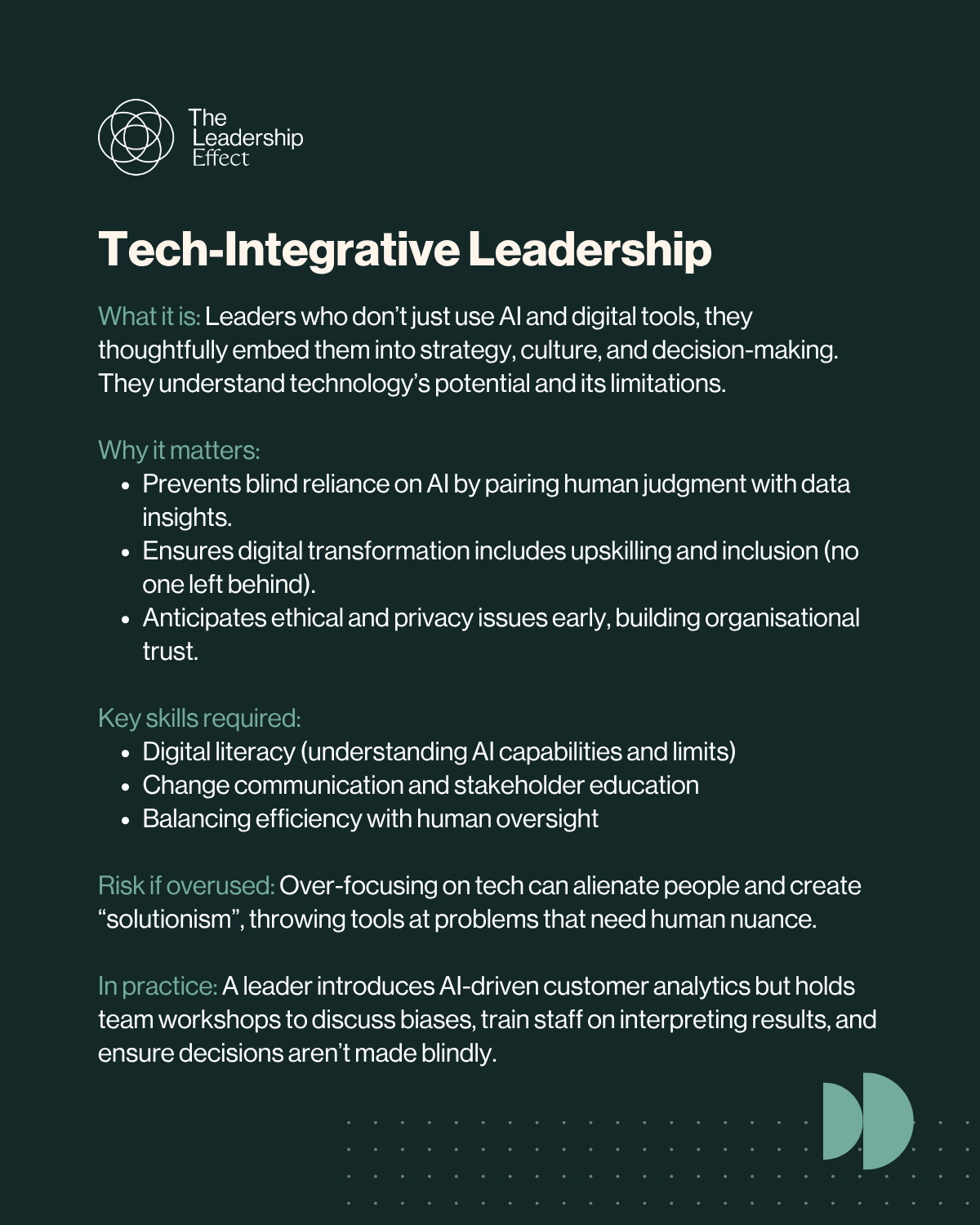
1. Tech-Integrative Leadership
What it is:
Leaders who don’t just use AI and digital tools, they thoughtfully embed them into strategy, culture, and decision-making. They understand technology’s potential and its limitations.
Why it matters:
- Prevents blind reliance on AI by pairing human judgment with data insights.
- Ensures digital transformation includes upskilling and inclusion (no one left behind).
- Anticipates ethical and privacy issues early, building organisational trust.
Key skills required:
- Digital literacy (understanding AI capabilities and limits)
- Change communication and stakeholder education
- Balancing efficiency with human oversight
Risk if overused:
Over-focusing on tech can alienate people and create “solutionism”, throwing tools at problems that need human nuance.
In practice:
A leader introduces AI-driven customer analytics but holds team workshops to discuss biases, train staff on interpreting results, and ensure decisions aren’t made blindly.
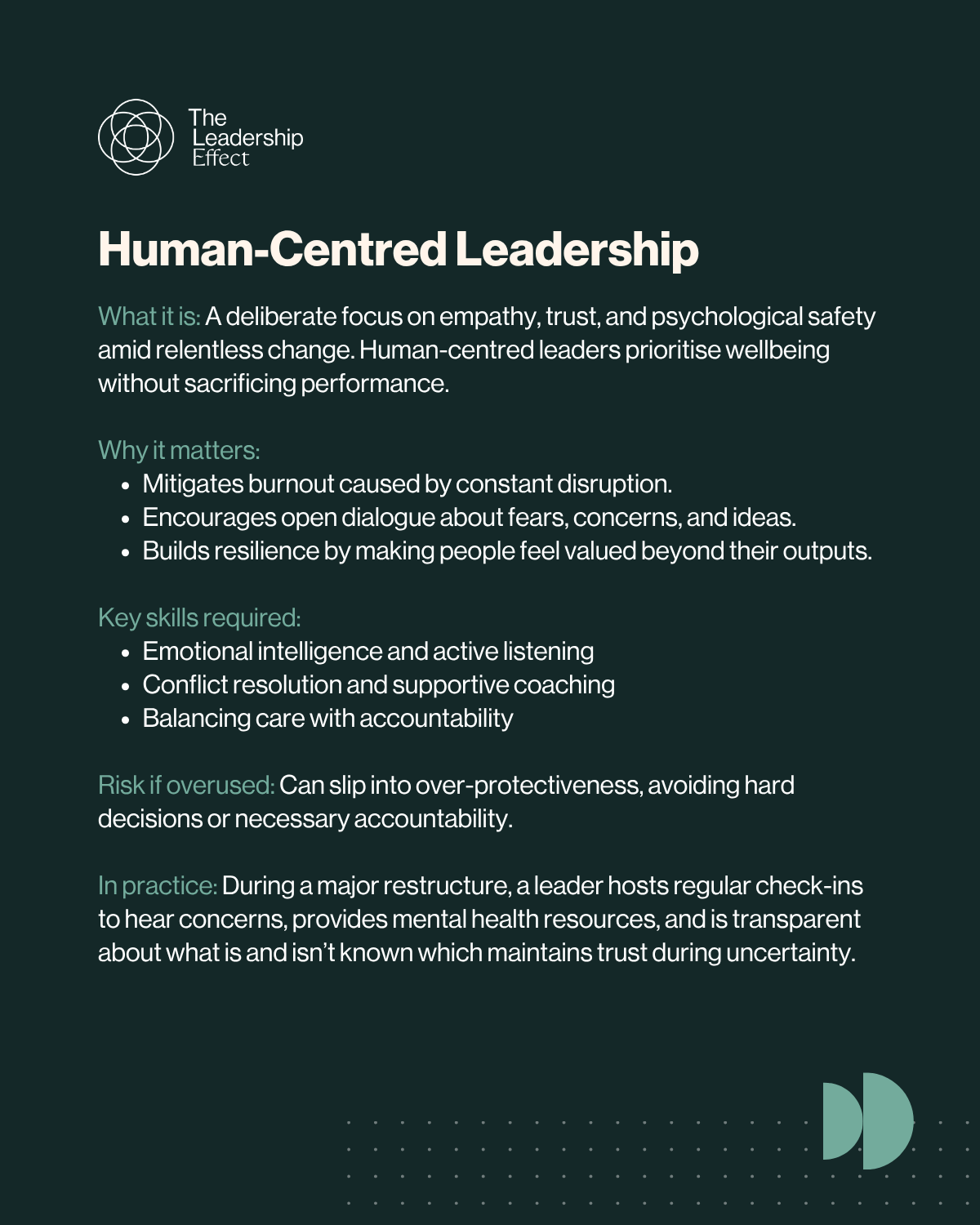
2. Human-Centred Leadership
What it is:
A deliberate focus on empathy, trust, and psychological safety amid relentless change. Human-centred leaders prioritise wellbeing without sacrificing performance.
Why it matters:
- Mitigates burnout caused by constant disruption.
- Encourages open dialogue about fears, concerns, and ideas.
- Builds resilience by making people feel valued beyond their outputs.
Key skills required:
- Emotional intelligence and active listening
- Conflict resolution and supportive coaching
- Balancing care with accountability
Risk if overused:
Can slip into over-protectiveness, avoiding hard decisions or necessary accountability.
In practice:
During a major restructure, a leader hosts regular check-ins to hear concerns, provides mental health resources, and is transparent about what is and isn’t known which maintains trust during uncertainty.
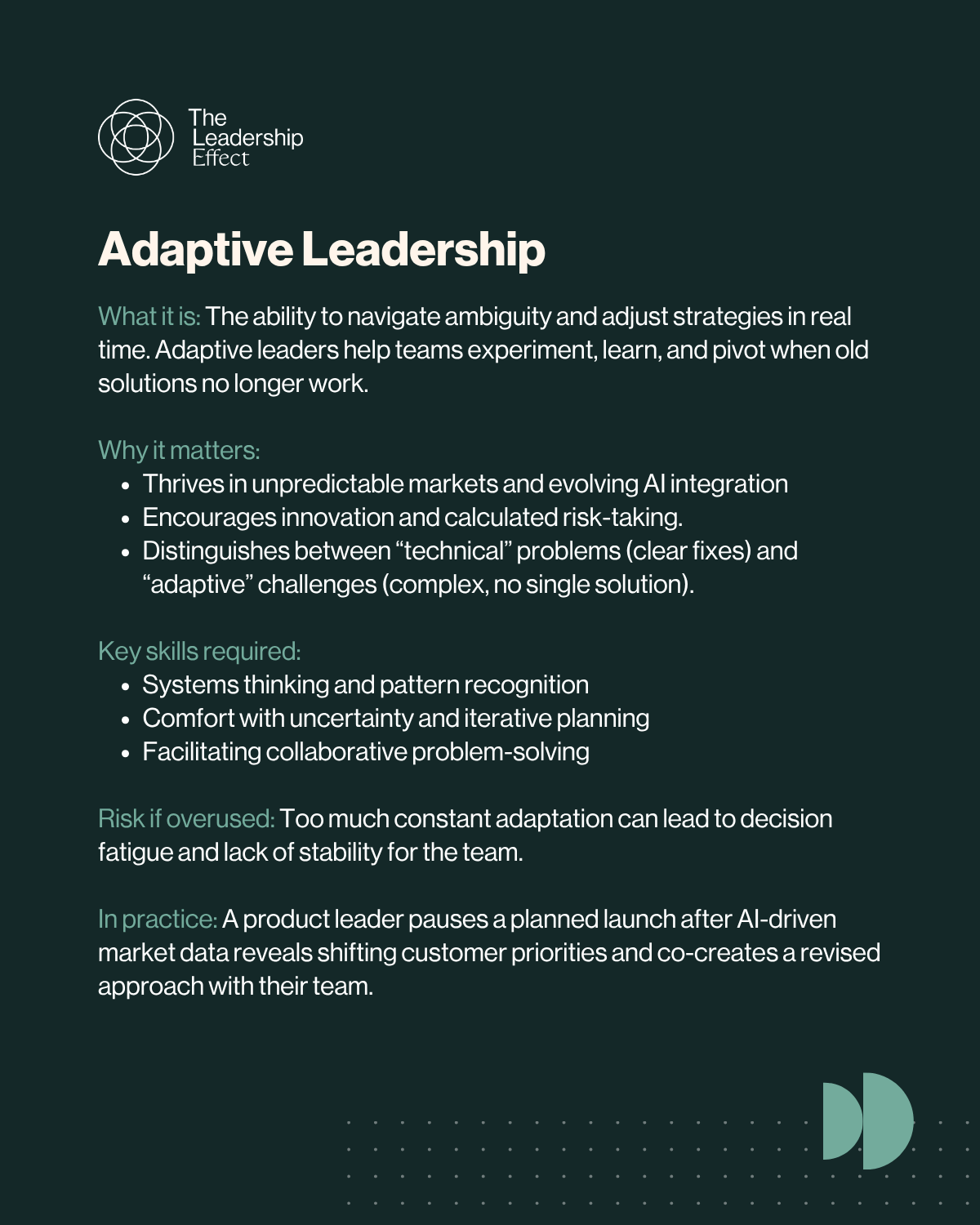
3. Adaptive Leadership
What it is:
The ability to navigate ambiguity and adjust strategies in real time. Adaptive leaders help teams experiment, learn, and pivot when old solutions no longer work.
Why it matters:
- Thrives in unpredictable markets and evolving AI integration
- Encourages innovation and calculated risk-taking.
- Distinguishes between “technical” problems (clear fixes) and “adaptive” challenges (complex, no single solution).
Key skills required:
- Systems thinking and pattern recognition
- Comfort with uncertainty and iterative planning
- Facilitating collaborative problem-solving
Risk if overused:
Too much constant adaptation can lead to decision fatigue and lack of stability for the team.
In practice:
A product leader pauses a planned launch after AI-driven market data reveals shifting customer priorities and co-creates a revised approach with their team.

4. Collaborative Network Leadership
What it is:
Leadership that extends beyond traditional hierarchies, building influence and results through ecosystems, partnerships, and networks rather than formal authority.
Why it matters:
- AI innovation often emerges externally; leaders must collaborate across industries and functions.
- Matrixed and hybrid teams require influence skills, not just positional power.
- Breaking down silos accelerates innovation and agility.
Key skills required:
- Relationship building across boundaries
- Negotiation and shared decision-making
- Building “networks of trust” rather than strict hierarchies
Risk if overused:
Too much collaboration without clear direction can slow progress or create decision gridlock.
In practice:
A leader tackling AI ethics engages cross-functional teams (legal, tech, HR, and external experts) to co-create a company-wide framework.
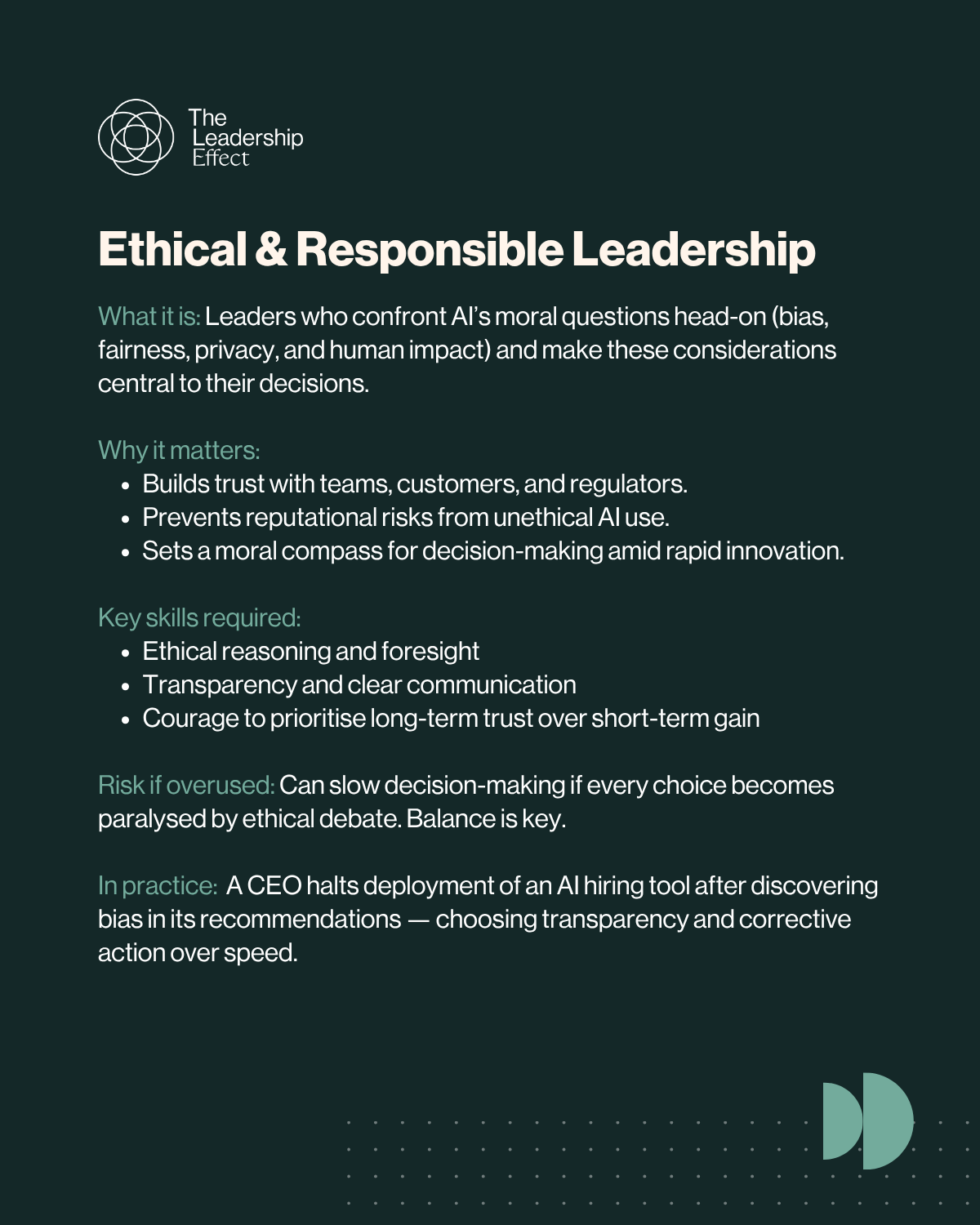
5. Ethical & Responsible Leadership
What it is:
Leaders who confront AI’s moral questions head-on (bias, fairness, privacy, and human impact) and make these considerations central to their decisions.
Why it matters:
- Builds trust with teams, customers, and regulators.
- Prevents reputational risks from unethical AI use.
- Sets a moral compass for decision-making amid rapid innovation.
Key skills required:
- Ethical reasoning and foresight
- Transparency and clear communication
- Courage to prioritise long-term trust over short-term gain
Risk if overused:
Can slow decision-making if every choice becomes paralysed by ethical debate. Balance is key.
In practice:
A CEO halts deployment of an AI hiring tool after discovering bias in its recommendations — choosing transparency and corrective action over speed.
The Cultural Ripple Effect of Modern Leadership Types
These modern styles don’t just impact projects, they shape organisational culture:
- Trust: Human-centred and ethical leadership create psychological safety and loyalty.
- Innovation: Adaptive and tech-integrative leaders foster experimentation without fear of failure.
- Engagement: Collaborative approaches give people a voice, driving commitment and belonging.
When combined, these leadership types create cultures capable of thriving amid complexity by balancing speed, ethics, and humanity.

Reflection: Where Do You Lead From?
Consider these questions to identify your growth edge:
- Which of these emerging leadership types comes most naturally to me?
- Where might my leadership style feel outdated in an AI-driven context?
- Am I balancing tech integration with human connection?
- How often do I flex my leadership style to match the situation, or do I lead on autopilot?
- Which of these leadership types would challenge me the most to develop — and why?
- How do my team’s needs right now align (or clash) with my natural leadership style?
- What signals tell me it’s time to pivot my leadership style?
- How well do I understand the ethical and cultural implications of using AI in my leadership decisions?
- In moments of rapid change, what do my team most need from me that I might overlook?

The Future of Leadership
AI and disruption won’t slow down. The leaders who thrive won’t cling to “how we’ve always done it”; they’ll be the ones who blend tech-savvy with human-centred wisdom, flexing between models as circumstances demand.
Modern leadership is about integration: innovation with ethics, speed with empathy, adaptability with vision. This isn’t just the future of leadership, it’s the expectation right now.
Next Step: Build Your Modern Leadership Toolkit
The Leadership Effect equips executives and teams to navigate AI and rapid change with grounded strategies and human-first leadership practices. Book a Discovery Session to explore how we can support your leadership evolution.