

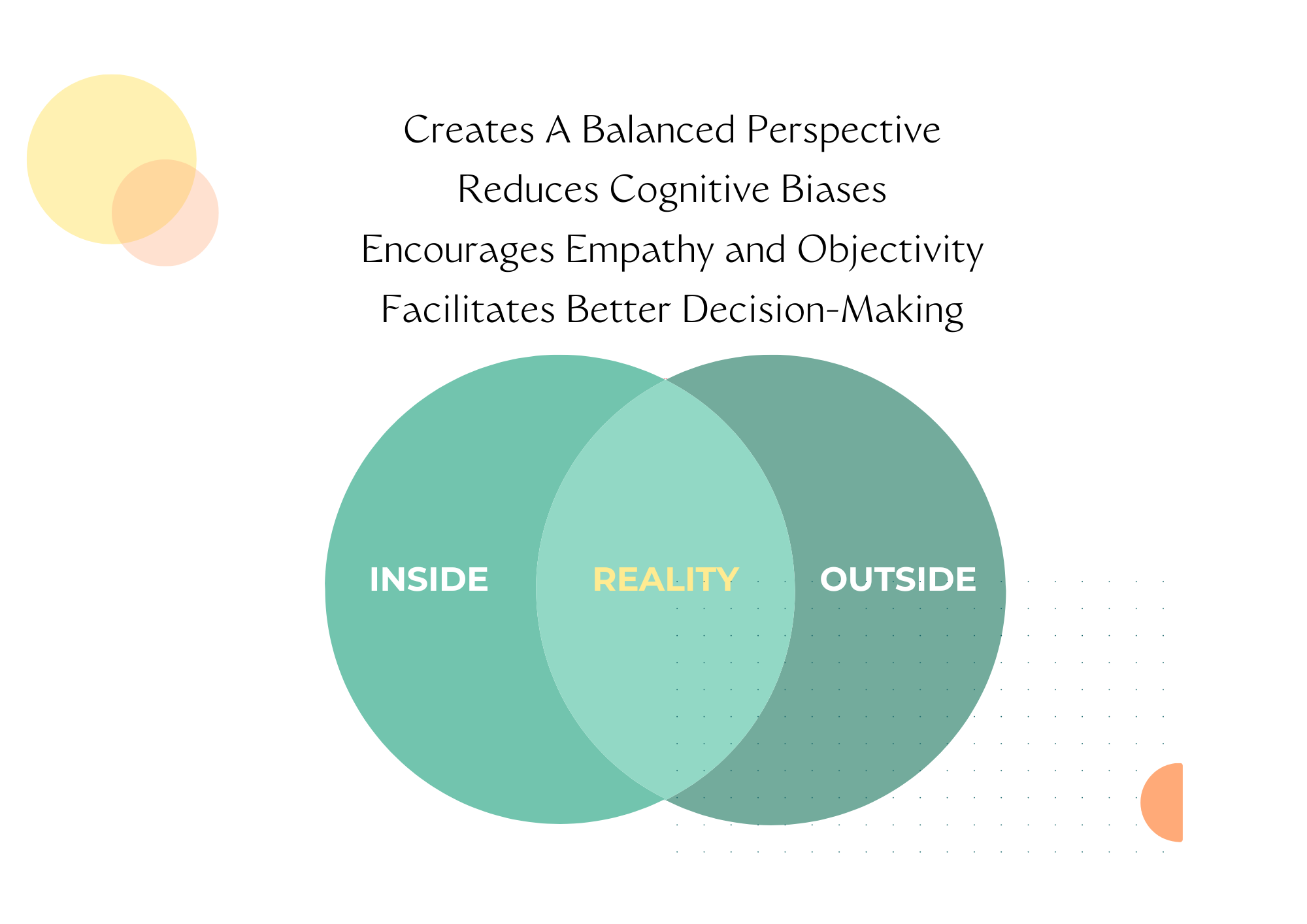
‘Where Accuracy Lives’ revolves around understanding the nuances of personal (inside) and external (outside) views to arrive at the ‘reality’ or the most accurate understanding of a situation. This exercise is particularly powerful in allowing you to take a step back, to consider different perspectives and then reflect on what you learn from the exercise in how a change in perspective occurs. The process leads to more effective problem-solving and decision-making in both personal and professional contexts.
“Visionary decision-making happens at the intersection of intuition and logic.”
Paul O’Brien,
Great Decisions, Perfect Timing: Cultivating Intuitive Intelligence
How Does “Where Accuracy Lives” Help Leadership?
“Where Accuracy Lives” is a decision-making framework that blends internal insights and external viewpoints. This approach allows you to create a deeper understanding of the challenges and opportunities, significantly improving decision quality.
4 Benefits Of Using Where Accuracy Lives in Business:
- Balanced Perspective: By considering both internal (inside view) and external (outside view) perspectives, this tool helps in achieving a more balanced and realistic understanding of any situation.
- Reduces Cognitive Biases: It counteracts our natural tendency to rely solely on personal beliefs and experiences, opening up the possibility of more pragmatic and unbiased solutions.
- Encourages Empathy and Objectivity: Where Accuracy Lives promotes empathy by prompting individuals to view situations from others’ viewpoints. This enhances interpersonal understanding and collaboration.
- Facilitates Better Decision-Making: By merging different perspectives, it leads to more informed and effective decisions.
How To Use “Where Accuracy Lives”?
Let me guide you through the step by step process of using “where accuracy lives”.
STEP 1: Inside View
- Description: Begin by describing the challenge from your personal perspective, considering your experiences, beliefs, and the impact on the business.
- Analysis: Reflect on how your personal biases and experiences might be shaping your view of the situation.
STEP 2: Outside View
- Objective Description: Attempt to describe the same situation as if you were an outsider, such as a coworker observing the problem.
- Advice and Perspective: Consider what advice you might give to someone else in this situation. Reflect on how this perspective differs from your own.
- Research and Base Rates: Investigate external data or base rates that can provide additional insight into the challenge.
STEP 3: Merging Perspectives
- Intersection of Views: Combine the insights from both inside and outside perspectives to identify the most realistic and accurate understanding of the situation.
- Reflection: After completing the exercise, reflect on whether this process changed your perspective and why.

What are the Key Challenges when Using “Where Accuracy Lives”?
Implementing the “Where Accuracy Lives” framework comes with a number of challenges despite its potential benefits.
Here are the key challenges associated with using this approach:
- Resistance to Change
- Time-Intensive Process
- Subjectivity
- Limited Access to External Perspectives
- Overemphasis on External Input
- Difficulty In Balancing Views
- Resistance to External Input
- Complexity In Communication
- Lack of Guidelines
- Difficulty In Measuring Impact
- Resistance to Reflection
- Resource Constraints
Resistance to Change
Employees and leaders accustomed to traditional decision-making models may resist adopting a dual-lens approach, leading to challenges in implementing the new framework.
Time-Intensive Process
Going through the inside-outside view exercise can be time-consuming, potentially hindering decision-making in situations that require swift responses.
Subjectivity in the Middle Ground
Determining the accurate intersection between the inside and outside views may be subjective, introducing the risk of bias in the final decision-making process.
Limited Availability of External Perspectives
In some situations, relevant external perspectives may be challenging to obtain, especially in rapidly evolving or confidential scenarios.
Overemphasis on External Input
There is a risk of over-reliance on external perspectives, potentially diluting the expertise and insights that come from an organisation’s internal knowledge.
Difficulty in Balancing Views
Striking a balance between internal and external perspectives can be challenging, leading to decisions that may lean too heavily in one direction.
Resistance to External Input
Some leaders may resist considering external perspectives, viewing them as unnecessary or less valuable than their own experiences.
Complexity in Communication
Communicating the intricacies of the inside-outside view dynamic to team members might be challenging, potentially leading to confusion or misinterpretation.
Lack of Clear Guidelines
The framework may lack clear guidelines on how to handle situations where the inside and outside views significantly diverge, leaving decision-makers without a standardised approach.
Difficulty in Measuring Impact
Assessing the actual impact of using the framework on decision quality and outcomes may be challenging, making it difficult to demonstrate its effectiveness.
Resistance to Reflection
Some leaders may resist the reflective aspect of the model, especially if it challenges their established beliefs, hindering the potential for personal and organisational growth.
Resource Constraints
Small teams or those facing resource constraints may find it challenging to dedicate the time and effort required for the inside-outside view exercise.

How to Overcome The Challenges of Using “Where Accuracy Lives”
To address the challenges associated with implementing the “Where Accuracy Lives” framework, leaders can consider using the below strategies to resolve a particular challenge.
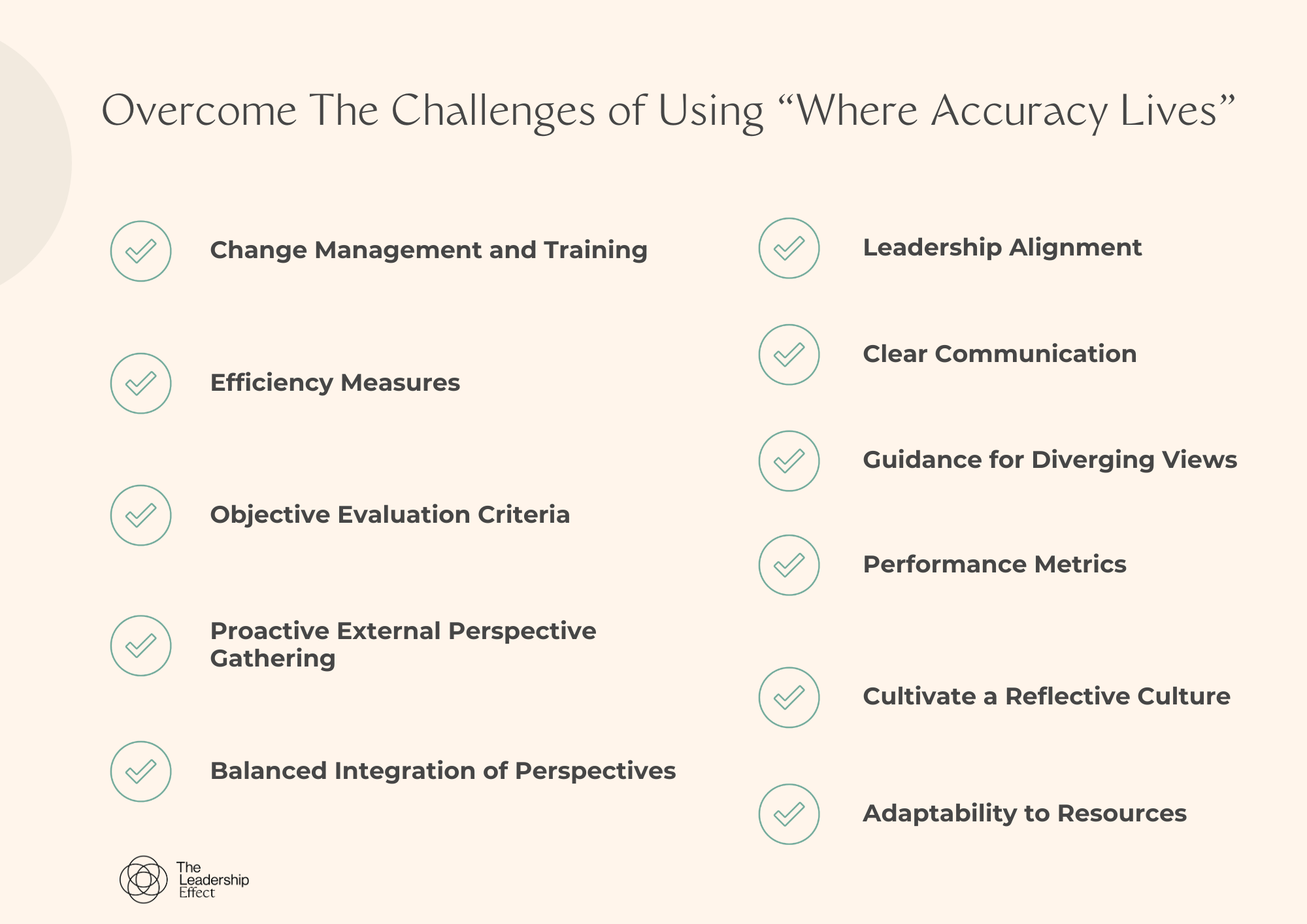
Change Management and Training
- Provide comprehensive training to leaders and teams to familiarise them with the framework.
- Implement change management strategies to mitigate resistance, emphasising the benefits of improved decision-making.
- To learn different change management strategies from Harvard, click here.
Efficiency Measures
- Develop guidelines or streamlined processes to make the inside-outside view exercise more efficient.
- Identify situations where a quicker decision-making process is necessary and adjust the framework accordingly.
Objective Evaluation Criteria
- Establish clear criteria for determining the accurate intersection between inside and outside views, reducing subjectivity in decision-making.
- Encourage transparency in the decision-making process by documenting how the intersection was reached.
Proactive External Perspective Gathering
- Build a culture of seeking external input regularly, ensuring that relevant perspectives are readily available when needed.
- Establish networks or partnerships that facilitate the exchange of insights with external stakeholders.
Balanced Integration of Perspectives
- Emphasise the importance of balancing internal and external perspectives.
- Encourage leaders to consider both views collaboratively rather than viewing them as mutually exclusive.
Leadership Alignment
- Ensure that leadership is aligned with the framework and sets an example by actively engaging in the inside-outside view exercise.
- Address any discrepancies in leadership perspectives to maintain consistency in decision-making.
Clear Communication
- Develop clear and concise communication strategies to explain the framework to team members.
- Provide ongoing communication about the benefits and progress of using the framework to maintain team engagement.
Guidance for Diverging Views
- Establish protocols for situations where internal and external perspectives significantly diverge.
- Clearly define decision-making processes in these scenarios to prevent ambiguity.
Performance Metrics
- Develop metrics to measure the impact of the framework on decision quality and outcomes.
- Regularly evaluate and adjust the framework based on the feedback and results obtained.
Cultivate a Reflective Culture
- Promote a culture that values reflection and continuous learning.
- Encourage leaders to openly share how the inside-outside view exercise impacted their perspectives and decisions.
Adaptability to Resources
- Tailor the implementation of the framework to accommodate resource constraints.
- Provide alternative, resource-efficient methods for smaller teams while maintaining the core principles of the framework.
Case Studies Of Using “Where Accuracy Lives”
Scenario 1: Implementing Remote Work Policies
Inside View
Problem: A manager notices a decline in team productivity and suspects it might be due to the recent shift to remote work.
Personal Perspective: The manager feels that remote work is less effective due to reduced in-person collaboration and oversight.
Manager’s Concern: The manager has observed a noticeable drop in team productivity since the transition to remote work. They feel that the lack of face-to-face interaction and the informal communication that happens in an office setting are missing, leading to misunderstandings and delays.
Team Feedback: Some team members have expressed feelings of isolation and confusion over priorities and tasks, while others appreciate the flexibility and lack of commute.
Business Impact: There’s a concern that prolonged remote work might be negatively impacting the company culture, employee engagement, and potentially leading to higher turnover rates.
Additional Perspectives:
Human Resources View: HR notices an increase in employees seeking mental health support and raises concerns about work-life balance in a remote setting.
IT Department’s Insight: The IT team reports that there are technical challenges and a need for better tools and security measures for remote work.
Outside View:
Industry Trends: Many companies in the industry are reporting higher overall employee satisfaction and even increased productivity with remote work. There’s a growing trend towards adopting hybrid models.
Consultant Advice: A management consultant suggests that remote work, when implemented with the right tools and clear policies, can lead to increased productivity and employee satisfaction.
Merging Perspectives (Expanded Detail):
Synthesised Approach: The manager decides to conduct a comprehensive survey to understand employee preferences and challenges in remote work. They plan to implement a hybrid model that offers flexibility while addressing the need for in-person collaboration. The company invests in better communication tools and remote work training for managers to improve remote team management skills.
Scenario 2: Introduction of a New Technology
Inside View:
Problem: A tech company is struggling to decide whether to adopt a new technology that could potentially revolutionise their product offerings.
Lead Developer’s Enthusiasm and Concerns: The lead developer is excited about the potential of the new technology to innovate but is concerned about the steep learning curve for the team and the integration challenges with existing systems.
Financial Perspective: The finance department is worried about the costs involved in training and implementation, and the potential disruption to current revenue-generating projects.
Sales Team’s Input: The sales team is unsure how the new technology will be received by the existing customer base and whether it will actually meet market needs.
Additional Perspectives:
Customer Feedback: Some key customers have shown interest in advanced features that the new technology could enable.
Competitor Analysis: Competitors are gradually moving towards similar technologies, potentially threatening the company’s market position.
Outside View (Expanded Detail):
Market Analysis: Market research shows a growing demand for the advanced capabilities offered by the new technology. Early adopters in the industry are gaining a significant competitive advantage.
Expert Opinion: Industry experts highlight the importance of staying ahead in technology trends and how the new technology could open up new market opportunities.
Merging Perspectives (Expanded Detail):
Strategic Decision: The company decides to initiate a pilot project incorporating the new technology, focusing on a small, manageable scope that aligns with current market trends and customer needs.
Risk Mitigation: They plan for phased training and implementation to minimise disruption, accompanied by a strong change management strategy. The finance department sets aside a dedicated budget for this initiative, ensuring it doesn’t impinge on existing critical projects.
Feedback Loop: The company establishes a feedback mechanism to continually assess the project’s impact on business goals and customer satisfaction, ensuring alignment with market needs and internal capabilities.
Where Accuracy Lives – A Powerful Decision-Making Framework
“Where Accuracy Lives” provides a powerful framework for decision-making, merging internal and external perspectives. Despite challenges such as resistance and time constraints, solutions exist through training, streamlined processes, and clear communication. By establishing objective criteria, balancing perspectives, and building a reflective culture, leaders can overcome hurdles and harness the framework’s benefits.
Embracing change, measuring impact, and adapting to resource constraints are key elements in cultivating a strong decision-making environment. Ultimately, this approach empowers leaders to navigate complexities, reduce biases, and make informed decisions that contribute to organisational resilience and success.